Scale personalized leadership journeys
Why do capable organizations with strong strategies still struggle when leadership transitions arise?
It isn’t because growth plans are weak or talent is scarce. In most boardrooms, performance metrics are stable, strategies are well-articulated, and expansion roadmaps are clearly defined. Yet when a critical leadership role suddenly opens, many organizations hesitate.
The reason is simple and uncomfortable: leadership readiness has not been built with the same rigor as business strategy.
How prepared an organization is to absorb leadership change—planned or unplanned—has quietly become one of the most decisive factors of sustainable growth in the next business cycle. As organizations head into aggressive expansion cycles, many are discovering that ambition has outpaced their leadership bench strength.
Table of content
- A Crisis Hiding in Plain Sight
- The Hidden Financial Drain
- A Crisis Hiding in Plain Sight
- When Leadership Gaps Become a Culture Problem
- Why High-Potential Talent Is Paying Attention
- Why One-Off Programs Fall Short
- The Compounding Advantage of Leadership Acceleration
- The ROI Boards Can No Longer Ignore
- From Crisis Management to Strategic Readiness
- The Question That Matters Most
- What We’re Rolling Out Next
A Crisis Hiding in Plain Sight
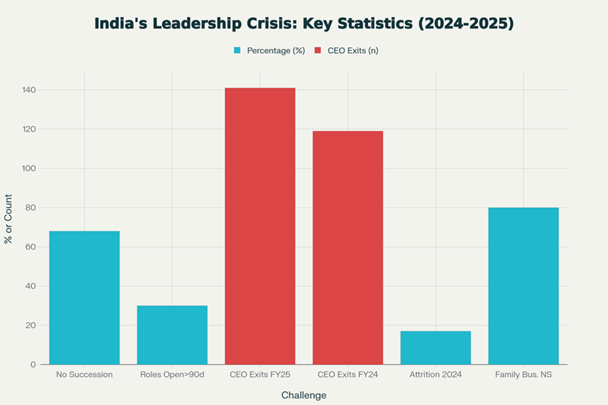
The data paints a worrying picture. A majority of Indian organizations still lack formal succession planning. Senior roles often remain unfilled for months, while CEO exits continue to rise year after year. This isn’t normal churn it’s instability at the top.
At a time when India is positioning itself for exponential economic growth, the real constraint isn’t capital or strategy. It’s the shortage of leaders who are prepared to operate at the next level of complexity.
India doesn’t lack talent. It lacks ready-now leadership.
The Hidden Financial Drain
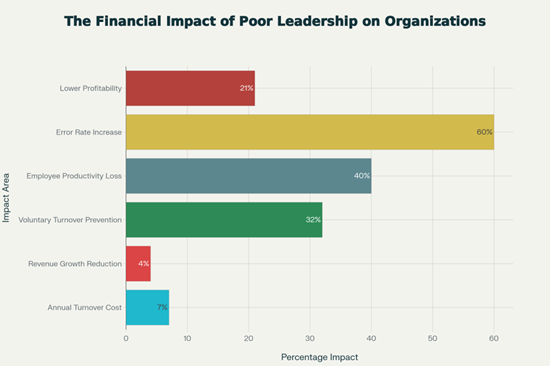
Leadership gaps rarely show up as a single cost line. Instead, they quietly erode performance.
Weak leadership reduces revenue growth, slows decisions, increases errors, and stalls innovation. Organizations often respond by hiring externally an expensive and risky solution. Factoring in recruitment, onboarding, and lost productivity, replacing a senior leader can cost several times their annual salary, with a high probability of failure within the first 18 months.
By contrast, building leaders internally through a structured Leadership Development Platform is far more cost-effective and culturally sustainable. Yet many organizations still underinvest until a crisis forces their hand.
A Crisis Hiding in Plain Sight
Consider the data:
- 68% of Indian organizations do not have a formal leadership succession plan
- Over 30% of senior leadership roles remain vacant for more than 90 days
- FY25 saw 141 CEO exits in India, a 19% jump from the previous year
This is not routine churn. This is volatility at the top.
And it’s unfolding precisely when India is aiming to scale its economy tenfold an ambition that demands not just capital and infrastructure, but a dramatic expansion of leadership capacity across sectors.
The uncomfortable truth? India is not short on ambition. It is short on ready leaders.
When Leadership Gaps Become a Culture Problem
The impact goes far beyond financials. Poor leadership reshapes workplace culture.
Low engagement, rising attrition, mistrust, and burnout are increasingly common across India Inc. Employees are far more likely to disengage or exit when leaders struggle with communication, empathy, and decision-making under pressure.
Even leaders themselves are under strain. Imposter syndrome, mental fatigue, and fear of failure are widespread at senior levels. When leadership behavior deteriorates, belief in the system erodes.
This is where leadership development becomes important. Programs like Executive Coaching and the Leader as a Coach mindset become critical not as perks, but as performance enablers.
Why High-Potential Talent Is Paying Attention
High-potential employees don’t leave just for better pay. They leave when they don’t see a future.
Organizations that provide clear development pathways retain their HiPos at significantly higher rates. High Potential readiness programs and intentional exposure to stretch roles signal one powerful message: you belong here long-term.
Without that signal, companies don’t just lose employees—they lose future CXOs, business heads, and transformation leaders, often to competitors who invested earlier in High Potential Leadership development.
Why One-Off Programs Fall Short
Many organizations recognize the problem but apply short-term fixes standalone workshops, offsites, or leadership days. While useful for awareness, these interventions fade quickly under operational pressure.
Leadership doesn’t fail due to lack of knowledge. It fails because, in moments of stress, people revert to deeply ingrained habits.
That’s why sustainable leadership readiness requires continuity. A modern Leadership Acceleration Platform focuses on longitudinal journeys combining structured learning, real-world application, mentoring, and coaching over time.
The real question isn’t, “Did they attend a program?” It’s, “Who are they becoming as leaders?”
The Compounding Advantage of Leadership Acceleration
Leadership development works like compounding interest.
One intervention creates insight. Continuous development builds judgment. Coaching sharpens decisions under pressure. Mentorship accelerates pattern recognition across successes and failures.
Over time, leaders become more resilient, consistent, and scalable. Research shows that leaders who receive ongoing coaching sustain behavior change far longer than those who attend isolated programs.
A well-designed Leadership Development Platform doesn’t just improve performance it builds durable leadership capacity.
The ROI Boards Can No Longer Ignore
Leadership development is often labeled a “soft” investment. The returns tell a different story.
Organizations across industries report significant ROI from improved team performance and innovation to higher return on equity. Indian companies are responding, with growing L&D investments and increased adoption of blended, digital-first leadership models.
A focused Leadership Workshop may spark momentum, but sustained returns come from integrated systems that combine learning, coaching, and measurement.
The question is no longer whether leadership development works. It’s whether delaying it is affordable.
From Crisis Management to Strategic Readiness
Resilient organizations treat leadership readiness as infrastructure.
They track succession rigorously, build multiple successor pipelines, design stretch experiences, and measure leadership trajectory not just program completion. Leadership development becomes a strategic capability, not an HR initiative.
This approach is especially critical for family-owned and promoter-led businesses, where succession planning is existential. Early preparation, clear governance, and objective development mechanisms make the difference between continuity and disruption.
The Question That Matters Most
As FY26 planning discussions focus on technology, growth, and cost optimization, one question often remains unasked:
Who is actually ready to lead us through what’s coming?
Leadership readiness is not optional. It is a growth strategy, a risk mitigator, and a competitive advantage.
Organizations that invest today in continuous leadership acceleration—through coaching, capability-building, and intentional development—will not only fill roles faster. They will build enterprises that can absorb shocks, scale intelligently, and retain belief at every level.
The leadership gap is already costing Indian organizations dearly.
The only real choice left is whether it remains invisible or finally gets addressed.
What We’re Rolling Out Next
As organizations prepare for FY expansion, leadership readiness cannot be left to chance.
We’re rolling out a HiPo Readiness Program a focused, 3-month leadership acceleration journey designed to prepare mid to senior management HiPos for next-level roles before growth plans go live.
What the journey includes:
- 360° Leadership Assessment to surface hidden strengths and blind spots
- 3–4 personalized leadership acceleration sessions focused on critical role-ready competencies
- Real-time progress tracking on an AI-powered platform
- Impact analysis to measure how leadership capability has actually shifted
12 weeks. Validated readiness. Scalable leadership.
Reach out to us at [email protected] or [email protected] to know more